Showing posts with label Aswath Damodaran. Show all posts

Friday, February 17, 2017

DAMODARAN WATCH: THE KIM KARDASHIAN OF VALUATION

AM | @agumack

Students know that I am a fan of Professor Aswath Domadaran. In class, I call him "The Lionel Messi of Finance". But it turns out that he calls himself "The Kim Kardashian of Valuation"! That's because, as he tells Barry Ritholz in the podcast below, he "shows everything". This is of course a reference to the tonnes of material that he publishes online. You can see some of the relevant links to the right. Anyway, here are some recent ideas from the man himself. Enjoy!

[1] Apple valuation. Prof. Damodaran calls Apple [Nasdaq: AAPL] the "Greatest Cash Machine in History" [see his detailed post]. (I remember that we used to say the same thing about Google a few years ago). In his Free Cash Flow to the Firm (FCFF) valuation, he arrives at a value per share of $129.02. As the market closed yesterday at $135.35, the shares are "fullly valued", although he will wait for a price of $140 before selling his position. Well done! In class at EU Business School, I use Apple as an example of how a company can successfully 'declare war on its WACC'. The Cupertino giant does that by outsourcing its production (lower beta), by turning the iPhone into a non-discretionary good (lower beta), by gently increasing its debt ratio, and by aggressively using interest rate and foreign currency swaps (lower cost of debt). 

[2] Podcast. Listen to this Barry Ritholz podcast with Professor Damodaran; he calls himself "The Kim Kardashian of Valuation". And he discusses lots of topics about finance, valuation, active vs. passive asset management, etc.

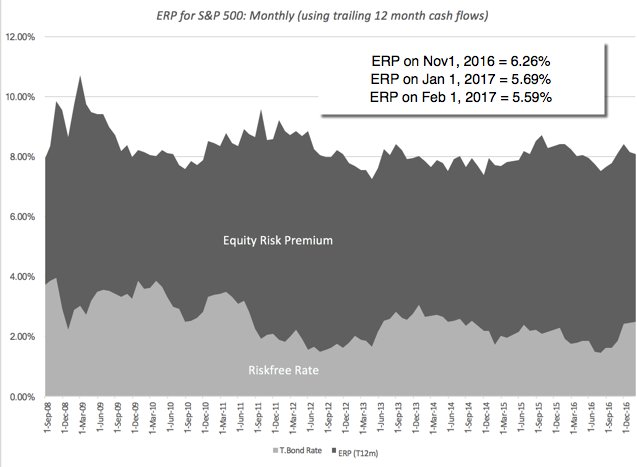
[3] Equity Risk Premium. On his Twitter account, Prof. Damodaran publishes his monthly estimation of the Equity Risk Premium. Instead of relying on historical data, he estimates the expected return on the S&P500 index by projecting cash flows in a two-stage growth version with a Terminal Value. We might take a look at that method this summer in Corporate Finance at EU Business School. The latest estimate: 5.59%.


 ______________

Thursday, January 12, 2017

A NEW BOOK BY PROFESSOR DAMODARAN

AM | @agumack

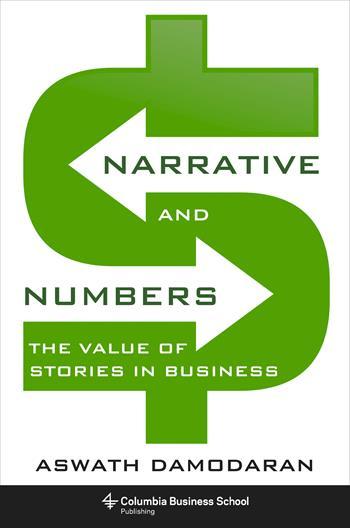
Exciting news! Professor Aswath Damodaran is out with a new book! Narrative and Numbers. The Value of Stories in Business has just been published by the Columbia Business School. As he explains in this post from his blog and on this presentation, he develops the valuation of four companies: Uber, Amazon, Alibaba and Ferrari. He is as interested about the story as it is conveyed by companies themselves as he is about the raw numbers. Here's Prof. Damodaran on his choices:

1. Uber, the ride-sharing phenomenon: I start with the story that I told about Uber in June 2014, and the resulting value, and how that story evolved over the next 15 months as I learned more about the company and its market/competition changed.

2. Amazon, the Field of Dreams Company: Amazon is a story stock that seems to defy the numbers laws and I use it to illustrate how the value for Amazon can vary as a function of the story you tell about it.

3. Alibaba, the China story: The China big market story has been used to justify the valuations of many companies, but Alibaba is one case where the use of that story is actually merited. In my story, Alibaba continues to dominate the growing Chinese online retail market and my value reflects that, but I also look at how that value will change if Alibaba can replicate its success globally (Alibaba, the Global Story).


4. Ferrari, the Exclusive Club: I value Ferrari as an exclusive club, leading into its IPO, and explore how that value will change if you assume that it will follow a different business model.


Reading Prof. Damodaran's book could be a very interesting undertaking for the Finance Club. Because Uber is still not a public company, I am pretty sure that the analysis will include 'bottom-up' beta calculations for the cost of equity. The Amazon story looks particularly interesting from a narrative point of view, as CEO Jeff Bezos has been incredibly spot-on. Alibaba would take us to the Chinese market (and the cost of capital calculations in the Chinese currency) while Ferrari is in a league of its own.
________________

Saturday, June 18, 2016

PROF. DAMODARAN ON 'BOTTOM-UP BETAS'

AM | @Mackfinance

"I'm actually wedded to bottom-up betas" — Aswath Damodaran

I have recently decided to devote more attention in class to what Prof. Damodaran calls 'bottom-up' betas. Students seem to find it interesting too. Here's some video material with the explanations:


1. Identify the business or businesses that make up the firm whose beta we are trying to estimate.

2. Calculate the levered betas of other publicly traded firms that are primarily or only in each of those businesses. Use regression analysis. In most businesses, there are at least a few comparable firms and in some businesses, there can be hundreds. Begin with a narrow definition of comparable firms, and widen it if the number of comparable firms is too small. Consider the possibilities of widening your search globally to get more firms in your sample. Do hundreds of regression! [TABLE]

3. Calculate the average of levered betas for each relevant sector.

4. Use the average debt-to-equity ratio (D/E) for each sector [this information will be provided] to ‘unlever’ the average beta with the formula: βU = βL / [ 1 + (1 – t) (D/E)]. This is the average unlevered beta for each division.

5. Calculate the bottom-up unlevered beta of the firm as a weighted-average of the unlevered betas for each division. But what weights do we use? There are two possibilities: use the proportion of the enterprise value of the businesses relative to the total enterprise value of the firm (enterprise value = market value of debt + market value of equity – cash). Or you could just use the revenues (sales) by sector.

6. Use the debt-to-equity ratio of the company to arrive at the levered beta, using the formula: βL = βU [ 1 + (1 – t) (D/E)]. That’s it!
_______________