AM | @Mackfinance
Andrew Hill, from the indispensable Financial Times, publishes a review of sorts of Jeff Gramm's book Dear Chairman. Board Battles and the Rise of Shareholder Activism (New York: HarperCollins, 2016) (*). Gramm —a hedge fund inversor and a professor at
Columbia Business School — tells the story of shareholder activism in the US from the 1920s to today. Hill singles out the battle between GM CEO Roger Smith and independent director Ross Perot about the ill-fated acquisition of Hughes Aircraft; he puts forward "the value of true director independence". From the editors:
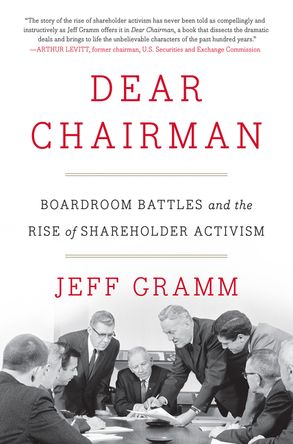
A sharp and illuminating history of one of capitalism’s longest
running tensions—the conflicts of interest among public company
directors, managers, and shareholders—told through entertaining case
studies and original letters from some of our most legendary and
controversial investors and activists. Recent disputes between
shareholders and major corporations, including Apple and DuPont, have
made headlines. But the struggle between management and those who own
stock has been going on for nearly a century. Mixing
never-before-published and rare, original letters from Wall Street
icons—including Benjamin Graham, Warren Buffett, Ross Perot, Carl Icahn,
and Daniel Loeb—with masterful scholarship and professional insight, Dear Chairman
traces the rise in shareholder activism from the 1920s to today, and
provides an invaluable and unprecedented perspective on what it means to
be a public company, including how they work and who is really in
control.
Jeff Gramm analyzes different eras and pivotal boardroom
battles from the last century to understand the factors that have caused
shareholders and management to collide. Throughout, he uses the letters
to show how investors interact with directors and managers, how they
think about their target companies, and how they plan to profit. Each is
a fascinating example of capitalism at work told through the voices of
its most colorful, influential participants. A hedge fund manager
and an adjunct professor at Columbia Business School, Gramm has spent as
much time evaluating CEOs and directors as he has trying to understand
and value businesses. He has seen public companies that are poorly run,
and some that willfully disenfranchise their shareholders. While he pays
tribute to the ingenuity of public company investors, Gramm also
exposes examples of shareholder activism at its very worst, when hedge
funds engineer stealthy land-grabs at the expense of a company’s long
term prospects.
(*) Andrew Hill: "Lasting lessons from smug CEOs and somnolent shareholders", Financial Times, 2 de febrero de 2016.
_______________
Showing posts with label Corporate Governance. Show all posts
Wednesday, February 3, 2016
Monday, March 11, 2013
[CORPORATE GOVERNANCE] BOARD STORIES
- Toyota: Outside directors for the first time. After spending the past four years battling crises, Toyota Motor Corp. signaled
it is ready to go on the offensive. The Japanese auto maker on Wednesday announced its biggest management
overhaul since founding-family scion Akio Toyoda took over as president in 2009.
The moves will open up the world’s No. 1 auto maker to its first outside
directors in its 76-year history, accelerate generational change in the
executive ranks and streamline the company’s decision-making. Among the three outside directors named to the board is Mark Hogan, a former
General Motors Co. executive who once ran a now-dissolved California joint
venture between Toyota and GM.
Commenting on the move to appoint outside directors for the first time, despite the relative insularity of Japanese businesses, Mr. Toyoda said the company wants to improve transparency after years of requests by shareholders to take on external board members. “As a global company, we’d like people to view us as an open company,” he said. The move by Toyota—Japan’s largest company by revenue—to add outside directors to its board marks a significant shift, not just for the auto maker, but also for corporate Japan. Major Japanese companies have, historically, been reluctant to bring outsiders into the boardroom.
Under Toyota’s new board, three of 16 directors, or 19%, will
be outsiders. In addition to Mr. Hogan, the company said it is nominating as
directors a Japanese life-insurance executive and the head of a company in
charge of clearing and settling securities transactions. The management changes
will take place pending a vote at the annual general shareholders’ meeting in
June.
[Yoshio Takahashi & Yoree Koh: "In Shake-Up, Toyota Turns to Outsiders", Wall Street Journal, 7 March 2013]
______________
- Transocean: calls for dividend. Transocean, the offshore drilling rig operator, plans to pay its first dividend for more than a year, as it responds to pressure from Carl Icahn, the activist investor who took a 5.6 per cent stake in the company in January. Transocean, the world's largest offshore drilling company by market capitalisation, said on Sunday that its board had recommended a divividend of $2.24 a share, worth a total of $800m, to be paid in installments from June 2013 to March 2014.
That is less than the $4 called for by Mr Icahn, who said in January he would put his demand at the annual meeting, set for May 17. The company stopped paying a dividend in March 2012 as credit rating warned that its debt could lose its investment-grade status.
[Ed Crooks: "Transocean responds to call for dividend payout", Financial Times, 5 March 2013].
______________
Thursday, March 7, 2013
[CORPORATE FINANCE] THE BOARD @UBS
The key roles and responsibilities for risk management and control are as follows:
The Board of Directors (BoD) is responsible for determining the firm’s risk principles, risk appetite and major portfolio limits, including their allocation to the business divisions. The risk assessment and management oversight performed by the BoD considers evolving best practices and is intended to conform to statutory requirements, as is the related disclosure in this section.
The BoD Audited is supported by the BoD Risk Committee, which monitors and oversees the firm’s risk profile and the implementation of the risk framework as approved by the BoD. The BoD Risk Committee also assesses and approves the firm’s key risk measurement methodologies. The Group Executive Board (GEB) implements the risk framework, controls the firm’s risk profile and approves all major risk policies. The Group Chief Executive Officer (Group CEO) is responsible for the results of the firm, has risk authority over transactions, positions and exposures, and also allocates portfolio limits approved by the BoD within the business divisions. The divisional Chief Executive Officers are accountable for the results of their business divisions. This includes actively managing their risk exposures, and ensuring that risks and returns are balanced.
The Group Chief Risk Officer reports directly to the Group CEO and has functional and management authority over risk control throughout the firm. Risk Control provides independent oversight of risk and is responsible for implementing the risk control processes for credit, country, market, investment and operational risks. This includes establishing methodologies to measure and assess risk, setting risk limits, and developing and operating an appropriate risk control infrastructure. The risk control process is supported by a framework of policies and authorities, which are delegated to Risk Control Officers according to their expertise, experience and responsibilities.
The Group Chief Financial Officer (Group CFO) is responsible for ensuring that disclosure of our financial performance is clear and transparent and meets regulatory requirements and corporate governance standards. The Group CFO is also responsible for the management of firm-wide treasury risks and for implementing the risk management and control framework for tax.The Group General Counsel is responsible for implementing the firm’s risk management and control principles for legal and compliance matters.
___________________
Subscribe to:
Posts (Atom)