Showing posts with label Books. Show all posts

Thursday, January 12, 2017

A NEW BOOK BY PROFESSOR DAMODARAN

AM | @agumack

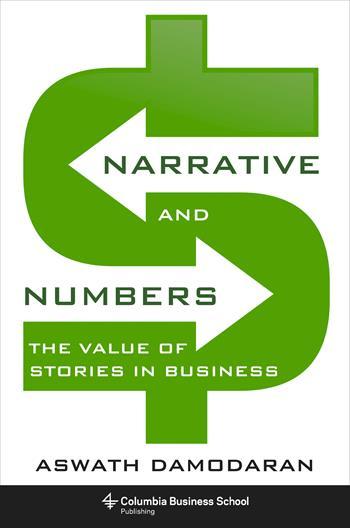
Exciting news! Professor Aswath Damodaran is out with a new book! Narrative and Numbers. The Value of Stories in Business has just been published by the Columbia Business School. As he explains in this post from his blog and on this presentation, he develops the valuation of four companies: Uber, Amazon, Alibaba and Ferrari. He is as interested about the story as it is conveyed by companies themselves as he is about the raw numbers. Here's Prof. Damodaran on his choices:

1. Uber, the ride-sharing phenomenon: I start with the story that I told about Uber in June 2014, and the resulting value, and how that story evolved over the next 15 months as I learned more about the company and its market/competition changed.

2. Amazon, the Field of Dreams Company: Amazon is a story stock that seems to defy the numbers laws and I use it to illustrate how the value for Amazon can vary as a function of the story you tell about it.

3. Alibaba, the China story: The China big market story has been used to justify the valuations of many companies, but Alibaba is one case where the use of that story is actually merited. In my story, Alibaba continues to dominate the growing Chinese online retail market and my value reflects that, but I also look at how that value will change if Alibaba can replicate its success globally (Alibaba, the Global Story).


4. Ferrari, the Exclusive Club: I value Ferrari as an exclusive club, leading into its IPO, and explore how that value will change if you assume that it will follow a different business model.


Reading Prof. Damodaran's book could be a very interesting undertaking for the Finance Club. Because Uber is still not a public company, I am pretty sure that the analysis will include 'bottom-up' beta calculations for the cost of equity. The Amazon story looks particularly interesting from a narrative point of view, as CEO Jeff Bezos has been incredibly spot-on. Alibaba would take us to the Chinese market (and the cost of capital calculations in the Chinese currency) while Ferrari is in a league of its own.
________________

Monday, February 15, 2016

LEHMAN BROTHERS & THE EFFICIENT MARKETS HYPOTHESIS

AM | @Mackfinance

"A generalised mutual suspicion" — John Plender

There is a new book out on the Lehman Brothers crisis. The author is Oonagh McDonald. There is much praise for the book from the Financial Times' reviewer John Plender, although he complains about MacDonald's "harshness based on hindsight" (*). The most interesting part comes from the critique of the Efficient Markets Hypothesis:

MacDonald examines how, one weekend in September, Lehman went from being valued by the stock market at $639bn to being worth nothing at all. It did not require much to make Lehman go up in smoke. At the end of its last financial year, it was so highly leveraged that its assets had only to fall in value by 3.6 per cent for the bank to be wiped out. The response of these Wall Street wizards to the credit crunch that began in mid-2007 was pure hubris. Having survived episodes of financial turmoil when many expected the bank to fail, Mr Fuld and his colleagues decided to take on more risk. Meanwhile, they neglected to inform the board that they were exceeding their self-imposed risk limits and excluding more racy assets from internal stress tests.

The board, conspicuously short of expertise in risk management and financial plumbing, enthusiastically endorsed the policy. A strength of McDonagh’s book is that it recognises that this was really a property-based crisis. Much of the decline in the value of Lehman’s assets came from direct exposure to property. Because Lehman brought other banks into these transactions, word about the deterioration in the quality of its assets quickly spread. A generalised mutual suspicion about the value of other banks’ assets became a hallmark of the crisis. 

But the conclusion is a broader, provocative exploration of the concept of market value, in which McDonald tilts at the efficient market hypothesis that underlay much of the thinking in finance ministries, central banks and regulatory bodies before the crisis. This incorporates the notion that competition between market participants will ensure that prices reflect all publicly available information. It leads to the conclusion that bubbles do not exist, which in light of the crisis many find absurd.

(*) John Plender: "Lehman Brothers crisis: A crisis of value. By Oonagh McDonald", Financial Times, 15 February 2016.
______________

Wednesday, February 3, 2016

BOOKS. CORPORATE GOVERNANCE & THE VALUE OF INDEPENDENCE

AM | @Mackfinance

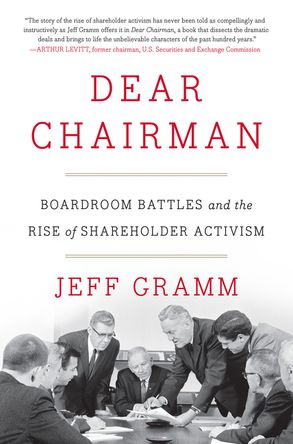
Andrew Hill, from the indispensable Financial Times, publishes a review of sorts of Jeff Gramm's book Dear Chairman. Board Battles and the Rise of Shareholder Activism (New York: HarperCollins, 2016) (*). Gramm —a hedge fund inversor and a professor at Columbia Business School — tells the story of shareholder activism in the US from the 1920s to today. Hill singles out the battle between GM CEO Roger Smith and independent director Ross Perot about the ill-fated acquisition of Hughes Aircraft; he puts forward "the value of true director independence". From the editors:


A sharp and illuminating history of one of capitalism’s longest running tensions—the conflicts of interest among public company directors, managers, and shareholders—told through entertaining case studies and original letters from some of our most legendary and controversial investors and activists. Recent disputes between shareholders and major corporations, including Apple and DuPont, have made headlines. But the struggle between management and those who own stock has been going on for nearly a century. Mixing never-before-published and rare, original letters from Wall Street icons—including Benjamin Graham, Warren Buffett, Ross Perot, Carl Icahn, and Daniel Loeb—with masterful scholarship and professional insight, Dear Chairman traces the rise in shareholder activism from the 1920s to today, and provides an invaluable and unprecedented perspective on what it means to be a public company, including how they work and who is really in control.

Jeff Gramm analyzes different eras and pivotal boardroom battles from the last century to understand the factors that have caused shareholders and management to collide. Throughout, he uses the letters to show how investors interact with directors and managers, how they think about their target companies, and how they plan to profit. Each is a fascinating example of capitalism at work told through the voices of its most colorful, influential participants. A hedge fund manager and an adjunct professor at Columbia Business School, Gramm has spent as much time evaluating CEOs and directors as he has trying to understand and value businesses. He has seen public companies that are poorly run, and some that willfully disenfranchise their shareholders. While he pays tribute to the ingenuity of public company investors, Gramm also exposes examples of shareholder activism at its very worst, when hedge funds engineer stealthy land-grabs at the expense of a company’s long term prospects.

(*) Andrew Hill: "Lasting lessons from smug CEOs and somnolent shareholders", Financial Times, 2 de febrero de 2016.
_______________